
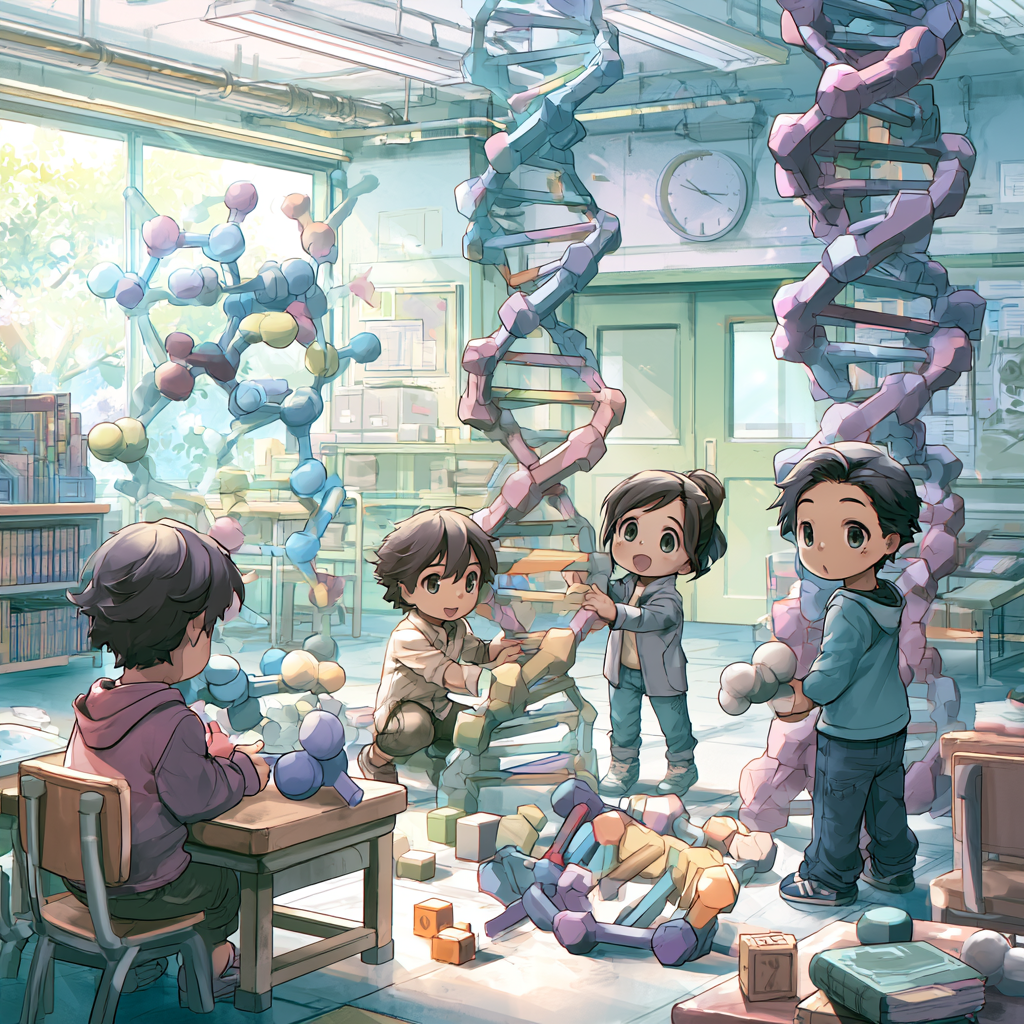
Students reach molecular biology from a variety of sources, but what if we started them off from it instead?
One of the most wonderful things about molecular biology is how empowering it is. Once you’ve learned about the central dogma, you become able to manipulate nucleic acids or proteins in hypothesis-driven ways that let you actively probe their functions – clone genes, tag molecules with fluorescent markers, engineer point mutations, and much, much more.
This empowerment is something that molecular biology shares with both chemistry and physics, whose students acquire agency very early on in their education. In chemistry, as soon as you’ve learned about the different elements you become able to create new compounds, or calculate the time it takes to boil a quantity of water; in physics you can build electrical circuits with predefined properties or predict the behaviour of projectiles. Similarly, in computer science, students can instruct machines to carry out tasks the moment they’ve mastered the basics of coding.
This ability – to absorb a subject’s fundamentals and utilise them in novel ways, or to take what you’ve learned and leverage that knowledge to actually create something new – is an intoxicating property. It’s the difference between simply accumulating knowledge (by no means worthless in itself!) and being able to apply it.
Curiously, this empowerment is something that tends to arrive much later in biology than it does in chemistry or physics. In biology, most of your early education is spent absorbing facts, usually starting at the whole-organism level, and with the molecular details of biochemistry, genetics, and the nucleic acid code coming later.
In other words, the way we learn about biology is to go from the diversity of life (all those David Attenborough documentaries!) to the universality of life. People come to biology by learning about the natural world and the dazzling diversity of it before the revelation that all living things are actually related and can trace their lineage back to the last universal common ancestor. Conversely in chemistry or physics (or computer science you go from universality to diversity – you learn about the fundamental building blocks before you start exploring all the various ways they get used.
Could this be turned around for biology? Rather than going from diversity to universality, might it in fact be possible to structure education the other way around, and teach children about DNA first? What would happen if we started students off by teaching them about the information aspect of biology, before turning to the myriad ways in which that information gets applied?
Truth is, you don’t necessarily need to understand the chemistry of life to grasp its informational aspect. There are 4 DNA bases, 2 DNA base pairs, a triplet code, and 20 amino acids. DNA makes RNA makes protein. You learn the triplet code, and you can learn how information flows from DNA into RNA and then into protein. You can learn from base pairing how DNA is transcribed into RNA (uridine can be left out at this stage, perhaps), and the 5’ to 3’ direction in which it’s made. You can even learn something of the properties of the 20 amino acids without needing to get too hung up on the chemistry – some are big, some are small, some like water and some don’t. If you change the DNA, you change the amino acid, and you change the protein’s properties.
Once you understand that all life is based on the same code, you get – as Darwin famously glimpsed – a new and more profound appreciation of how interconnected life is. There is an extraordinary unity and togetherness of the natural world once you start seeing animals and plants as following radically different biological strategies but using the same fundamental building blocks to do so. And what remarkable and astounding diversity of forms, textures, sizes that brings about – a simple garden is suddenly transformed into something pulsatingly alive when you know that every blade of grass is photosynthesising, every spoonful of soil is teeming with microbes and matted with fungi, and each bird nestling inside a treetrunk is surrounded by tissues every bit as alive as it is.
What kind of perspective would children acquire, if we started them off in this way? How would they ultimately view life, and themselves, and the world around them it if they were to begin with DNA and work outwards from it?
Molecular biology has, famously, always been more of a destination than a departure point. It was founded by refugee physicists fleeing the horrors of World War II and to this day remains a melting pot of different scientific backgrounds and interests, but what if, what if there was a generation that came to it early?
Acknowledgements: The idea for this posting originally came from a conversation with GW. Image generated using MidJourney.
 Total Internal Reflection
The problem lies in the word ‘dogma’. If you are telling children the profound truth of molecular biology, others will tell their children that this is equivalent to religious dogma, or that there are alternative truths. I think that learning needs to be accompanied by doing, but experiments in molecular biology are difficult. You can get a class of schoolchildren to make a stringy gel from a turnip and tell them that they have prepared DNA but that will not convince them that science is an activity open to everyone and transformative for the entire world. I had the privilege of attending as a middle aged biologist, studying with very young but highly selected US college students. Like the kids at school who surpassed me in knowing how to mend radio sets, the american kids actually brought their own sets of restriction enzymes, in neatly labelled Eppendorffs, just like the resistors and capacitors of some of my schoolfellows. We need to devise sets of experiments for schools where the young do molecular biological experiments and get answers to questions. This is very very hard. Sending off samples of DNA for sequencing will not cut it
LikeLiked by 1 person
Hi Brad, thanks so much for writing! I agree that the practical side of molecular biology is difficult, and that there’s too much of a gap between precipitating out DNA from fruit/veg and the informational aspect of what DNA is.
That said, I think it should be possible to lay the theoretical foundations using only models – scale models of nucleotides (or maybe just the bases) to see how base pairing works, then the triplet code (perhaps using tRNA models?), then the 20 amino acids. In that way I think it might be possible to lay the theoretical foundations in time for students to start “proper” chemistry lessons, by which time there might be incubators and autoclaves around.
I’m not sure that getting DNA sequenced doesn’t cut it though…I still remember the magic of preparing my first mini prep, and to then send a sample off for sequencing and subsequently getting the results was magical. It blew my mind that there was all that information floating around in 50 ul of clear liquid. 🙂
LikeLike
This is an interesting proposal, Brooke, but I wonder what would it take to make it would work. I teach the ‘central dogma’ (as terribly named as the ‘genetic code’) to BSc first-years and a bit more advanced molecular biology to second-years, and I struggle to consolidate the ideas throughout the cohorts, so I am quite interested in considering how this could be introduced earlier or differently. Usually, what DNA is and what it does is taught to students that already have notions of chemistry, so they are prepared to develop a mental model of such complex molecules. Of course, the beauty of the ‘central dogma’ is both in its elegant biochemical implementation and its conceptual simplicity — and the explanatory power they bring. So, one could try to dispense with the ‘material’ details of what DNA looks like and, as you say, focus on its conceptual properties (4 bases, 2 strands, 2 copies, 20 aminoacids), but then students would need to be capable of considerable abstraction (not to mention some notion of combinatorics). Then there’s the matter of ‘where’ is all this happening – for a satisfactory mental model, I think that this is essential. So students need to know that we are made of cells, and this information processing is happening in a distributed manner across the body of a macroscopic living being.So it seems to me that, to bring (significantly) forward the age of teaching about DNA and protein synthesis, we would need to either introduce some of the pre-requisite notions earlier, too, or find an ingenious way to simplify the way they are introduced. Do you have something in mind? I would be quite curious to know.I think there could be significant benefits to doing this beyond the ability to be creative (or at least think creatively) about how we ‘are built’ and ‘function’. I come across all sorts of educated people that have the most rudimentary understanding of genetics or how our bodies work. That creates a vulnerability that can be exploited by identity mongers and snake-oil sellers.
LikeLike
This is an interesting proposal, Brooke, but I wonder what would it take to make it would work. I teach the ‘central dogma’ (as terribly named as the ‘genetic code’) to BSc first-years and a bit more advanced molecular biology to second-years, and I struggle to consolidate the ideas throughout the cohorts, so I am quite interested in considering how this could be introduced earlier or differently. Usually, what DNA is and what it does is taught to students that already have notions of chemistry, so they are prepared to develop a mental model of such complex molecules. Of course, the beauty of the ‘central dogma’ is both in its elegant biochemical implementation and its conceptual simplicity — and the explanatory power they bring.So, one could try to dispense with the ‘material’ details of what DNA looks like and, as you say, focus on its conceptual properties (4 bases, 2 strands, 2 copies, 20 aminoacids), but then students would need to be capable of considerable abstraction (not to mention some notion of combinatorics). Then there’s the matter of ‘where’ is all this happening – for a satisfactory mental model, I think that this is essential. So students need to know that we are made of cells, and this information processing is happening in a distributed manner across the body of a macroscopic living being.So it seems to me that, to bring (significantly) forward the age of teaching about DNA and protein synthesis, we would need to either introduce some of the pre-requisite notions earlier, too, or find an ingenious way to simplify the way they are introduced. Do you have something in mind? I would be quite curious to know.As for how to introduce creativity, I would suggest cloning chromoproteins and transforming them. A simplified iGEM approach. But this requires resources, dedicated teachers, and dedicated students!I think there could be significant benefits to doing this beyond the ability to be creative (or at least think creatively) about how we ‘are built’ and ‘function’. I come across all sorts of educated people that have the most rudimentary understanding of genetics or how our bodies work. That creates a vulnerability that can be exploited by identity mongers and snake-oil sellers.
LikeLiked by 1 person
Hi Joaquin, good to hear from you! Before I reply in detail, I think it’s worth reiterating the two main impulses that prompted this piece: (1) in chemistry and physics, the learning arc goes from universality to diversity, whereas in biology it goes from diversity to universality; (2) in chemistry and physics, students are empowered early, whereas in biology they get empowered late.
That then begs three questions – what impact would it have if biology teaching was turned around, students got empowered early, and how would you go about this?
My hunch – although I appreciate this runs against your intuitions – is that you can strip all those material details away and even the spatial/intracellular details. Children can cope with some surprisingly complex mathematics, so a degenerate 4-letter code is a reasonable challenge, I think. Framing it as “the code of life” might seem quasi-mystical to begin with, but you can then progressively add on the biochemical details. And at the cellular level, I’d definitely stick with prokaryotes for all this – no need to overcomplicate matter with intracellular membrane-bound compartments… 🙂
LikeLike