

Just over a year ago, I wrote about the “chainsaw massacre” being perpetrated by Elon Musk and his acolytes at DOGE. At the time, these were the most visible elements – the most visible outrages – of the Trump Administration’s war on science and coupled to the beginnings of the anti-DEI ouster, suggested two initial impulses at work: a backlash firstly against the data-driven nature of scientific decision-making (anathema to those who wish to do as they will, unencumbered by facts, details, or restraints), and secondly against merit-based advancement (because education is the great equaliser and facilitates promotion through ability rather than patronage).
One year on, the destruction continues, with RFK Jr.’s wilful dismantling of America’s scientific funding and regulatory bodies now taking centre stage and with more strands to this general anti-intellectualism emerging.
Anti-intellectualism isn’t really the right label though, because the people responsible for this demolition (an odd coalition of MAGA nationalists, tech bros, and anti-vaccine wellness influencers) don’t appear to disdain intelligence – on the contrary, they act as if they believe they’re cleverer than everyone else, just like Trump bragging about not paying taxes (“That makes me smart”).
So the wholesale ruination of the American research engine isn’t an attack on intellectualism, it’s an attack on intellectuals. It’s an attack on people who’ve devoted their lives to accumulating knowledge and experience and insight, and who spend their working lives adding to that accumulation and transmitting it to others and using it to make the world a better place. It’s an attack on the kind of knowledge that intellectuals personify. And to do that, while believing that you’re smart yourself, you have to believe that the knowledge accumulated by intellectuals is of less value than they claim.
If we’re being (very!) generous, this is not, in its essence, a new argument. It’s a deterministic argument, a nature vs nurture argument, a brains vs experience argument. It’s the kind of position that people who claim they’re smart but who have little real-world experience are fond of taking and which, in a sense, makes it so apt that DOGE’s army of vandals were a bunch of pimply young men.
The COVID19 pandemic was in many ways an inflection point. On the one hand, the COVID19 vaccines represent one of the greatest scientific achievements of all time – a collective effort from untold numbers of scientists and physicians working around the globe to understand the SARS-CoV-2 virus and develop new biotech to combat it. On the other hand, it also seems to represent the point at which a distrust of experts crept out of internet conspiracy wells and first went mainstream.
I guess we all remember the exponents. People sat at home during the lockdowns and thinking “I’m clever, I have all the knowledge of the internet available to me, maybe I can figure this out for myself?”, and of course finding ample sources, some seemingly quite authoritative, that gave credence to their resentment at the involuntary house arrest.
The propagation of those fringe views en masse helped devalue the tacit knowledge and learning that expert scientists and physicians had gained through decades of experience in a particular area. There were some notable victims of this malaise even in scientific circles. The Nobel prize-winning theoretical chemist Mike Levitt, neither a virologist nor a public health expert, decided to reinvent himself as an amateur epidemiologist and went on to make a number of incorrect but widely-shared predictions about COVID19’s spread, using his name and platform to advocate against lockdowns.
Levitt provides a great example of “Nobel disease”, which is itself a manifestation of the Dunning-Kruger effect – an overconfidence in your abilities in areas that you’re unfamiliar with. The Dunning-Kruger effect is one of the key drivers of the American chainsaw massacre, because the anti-science purges are being driven by people who think they could walk into any job and instantly do it well. Brains count for more than experience, and if there’s one thing this crowd really has in abundance, it’s…confidence.
The genAI boom fits neatly into this general contempt and devaluation for experts and expertise – it’s part of a narrative that says that skilled people with experience aren’t worth as much as they claim and can be readily replaced. The most damaging insinuation in the whole inflationary AI bubble is that a nobody using an LLM – or even an LLM by itself – will be able to do the same job as an expert.
Except, it appears, time and again when there have been wholesale attempts to substitute experience with genAI it never quite works out as planned. But by then the damage is done. The experts have been felled, taking their know-how with them.
You can’t fix that kind of damage quickly because it’s experience that you’re getting rid of, the very experience that the vandals disdain. In Dr. Seuss’ parable of “The Lorax” the trees get felled for industry, but the Trump Administration’s chainsaw massacre is about destroying the scientific structures that enable data-driven judgement.
If there’s a silver lining, it’s perhaps that the Dunning-Kruger also describes how those with expertise often underestimate their real capabilities, just as those without relevant expertise overestimate them (that little green sliver in the chart below). Let’s hope they step up.
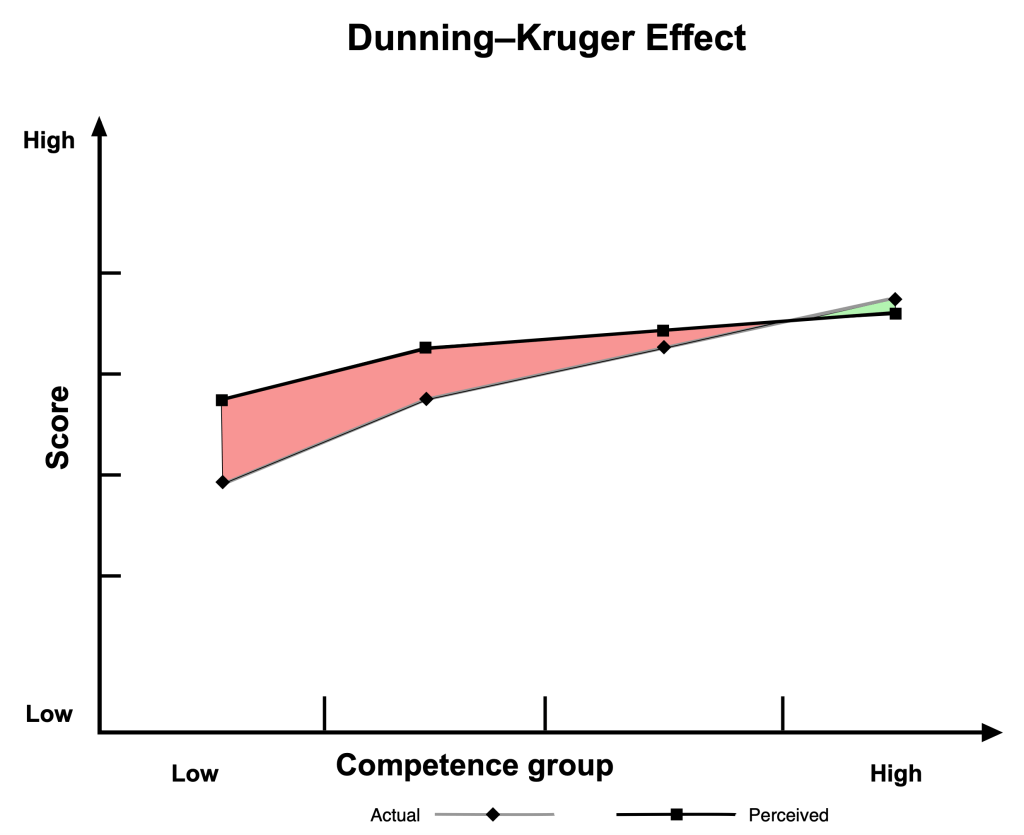
(Original artwork generated by Midjourney; Dunning-Kruger effect chart taken from Wikipedia.)

