

When scientists assess career options outside academia, there’s a prevailing misconception that MedComms is a variant of SciComm.
The trap, after all, is right there in the name. SciComm = science communication, MedComms = medical communications, so MedComms must basically be the same activity but dealing with medicine instead of scientific research, right?
Wrong. Here’s why.
The outputs are different
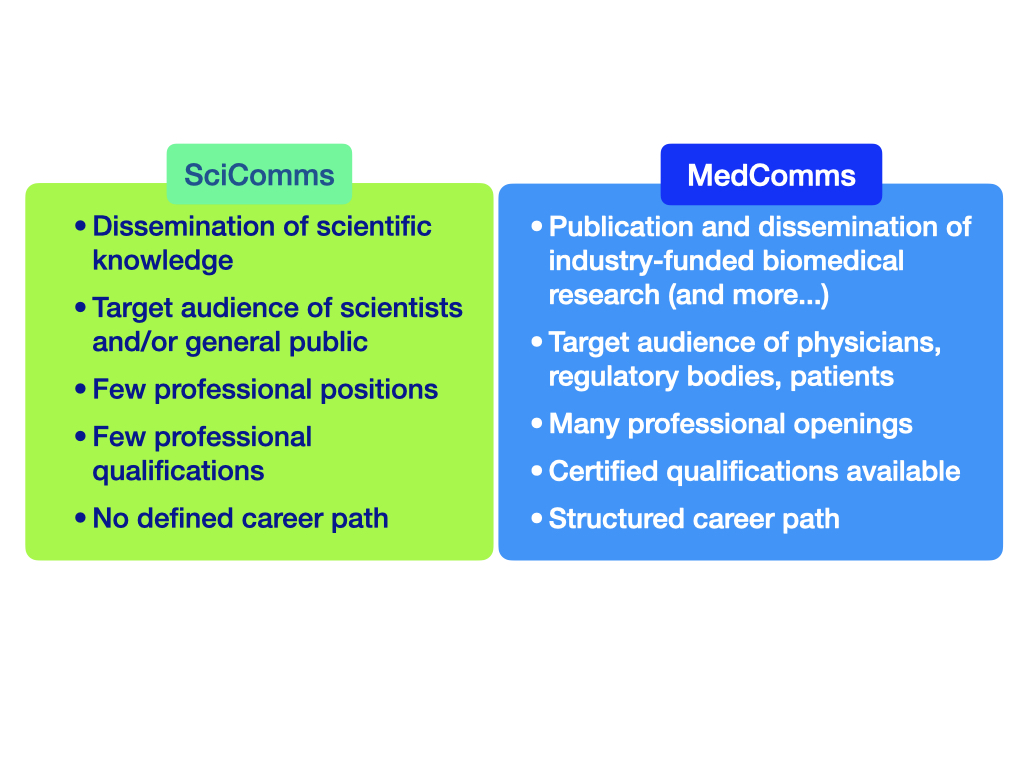
Broadly speaking, SciComms is about publicising recent (academic) research findings; by promoting recent research activity, it serves as an adjunct to the scholarly literature. The outputs might involve social media, videos, podcasts, press releases, blog postings, journalism, and even pop science books.
Conversely, MedComms is about the publication and dissemination of industry-funded (bio)medical research, covering the entire life cycle of a particular pharmaceutical product. It involves direct, not adjunct, contributions to the scholarly literature. For MedComms pubs specialists like myself, most of the outputs are familiar from academic research: manuscripts, conference abstracts, conference posters, conference oral presentations. And that’s not all! You might be writing reports from advisory board meetings, contributing to continuing medical education, and getting involved in MedAffairs work too.
The audiences are different
The target audience for SciComms work tends to be either other scientists who are working in the same research area or the general public (material for the latter sometimes falling into the “simplify, then exaggerate” school of science journalism).
Conversely, the primary target audience for MedComms work are physicians and, to a lesser extent, regulatory bodies and sometimes also patient groups.
There’s more job opportunities in MedComms
This is probably the biggest and most frustrating drawback for scientists exiting academia who wish to get involved in communications work: there are at present remarkably few genuine SciComm jobs. A lot of SciComms work actually gets done in people’s free time, and many of the scarce “SciComm” positions out there tend to come with a hefty administrative load and are unlikely to be permanent.
Conversely, MedComms has abundant openings* in both pharmaceutical firms and MedComms agencies (just go to LinkedIn and search for “medical writer”). Full-time, permanent positions are available and if you’re hired for the scientific side of the business you’ll actually spend your days doing what you expected to do: writing.
*Note that 2024-2025 were brutal years for the pharma sector and a lot of hiring freezes were put in place, but current indications are that things have turned and the work is beginning to come in again. More work means more people will be needed…openings should follow.
MedComms offers professional qualifications
Another (related) drawback of SciComm as a full-time professional career choice is that it doesn’t really have recognised qualifications as such. This is probably a reflection of the fact that as a career it’s still in its infancy and most contributors are volunteering their time on an amateur basis. Having a well-defined online presence or a large social media following is a plus, but the value can be hard to quantify.
Conversely, MedComms has industry-recognised professional qualifications that once attained, will let you present yourself as a Certified Medical Publication Professional, someone trained to uphold Good Publication Practice (GPP). Even before you become CMPP-qualified you’ll be benefitting from structured in-house training (another positive contrast with the still-prevalent Corinthian spirit of academia), and in addition there are multiple professional societies such as the International Society of Medical Publication Professionals and the European Medical Writers Association to provide support.
MedComms has a defined career path
Further compounding the lack of job openings and the lack of professional qualifications is the fact that SciComms doesn’t really have a defined career structure. You can be a successful communicator and you can point to your outputs as evidence of your work ethic, but as there isn’t really an industry sector focused squarely on this, the possibilities for career advancement are vague.
In contrast, MedComms has a structured and well-defined career path that goes from Associate Medical Writer to Medical Writer to Senior Medical Writer to Associate Scientific Director and beyond.
Why I’m glad I chose MedComms as an industry career
After I resigned from my position in academia, I think a lot of friends and colleagues were expecting me to either go in for SciComm or publishing, because it was no secret that I enjoyed writing.
Scientific publishing is a great career option but it’s one I decided against for reasons outlined below. SciComm was attractive but I realised pretty early on that there simply weren’t any openings, and it shares some of the disadvantages of a publishing career as well. I confess I’d never even heard of MedComms before I left academia (for some reason, it seems to fly under the radar and almost everybody stumbles into it) but once I discovered it I was pretty sure it was exactly what I was looking for, and every experience since then has borne that intuition out.
As a MedComms pubs specialist, I now spend my days preparing figures, writing manuscripts, helping shape those stories in collaboration with industry clients and expert physicians – in other words, taking all my favourite bits of academic research and applying those same skills to the publication and dissemination of industry-funded biomedical research. My name no longer appears as an author, but I still feel engaged and involved, and the intrinsic real-world relevance of everything we do is a massive buzz.
As a former researcher, and someone who lives and breathes and loves scientific research, this direct connection with the data is critically important. I don’t know why, and it might just be me, but I simply wouldn’t feel like a stakeholder if my role was to be promoting someone else’s research, as SciComm involves. It’s the same reason I decided that I didn’t want to be a journal editor – handling other people’s manuscripts would feel like standing outside of a shop window with my nose pressed up against the glass.
With MedComms, I’m feel as though I’m still involved in research, and I’m helping to shape the narratives of abstracts/posters/oral presentations/manuscripts that are coming out of clinical trials and other pharmaceutical activities.
To be clear, I’m not bashing SciComm. I love SciComm and I love doing SciComm (that’s what this blog is, after all) and if you can make SciComm work for you that’s a wonderful thing…but right now, I think MedComms offers a far more structured and satisfying non-academic career choice. It’s an entire sector of the biotech/pharma industry that is built around the application of writing/communicating/organising skills. I still do SciComm in my free time, but it’s MedComms, not SciComm, that I get paid for.
 Total Internal Reflection