
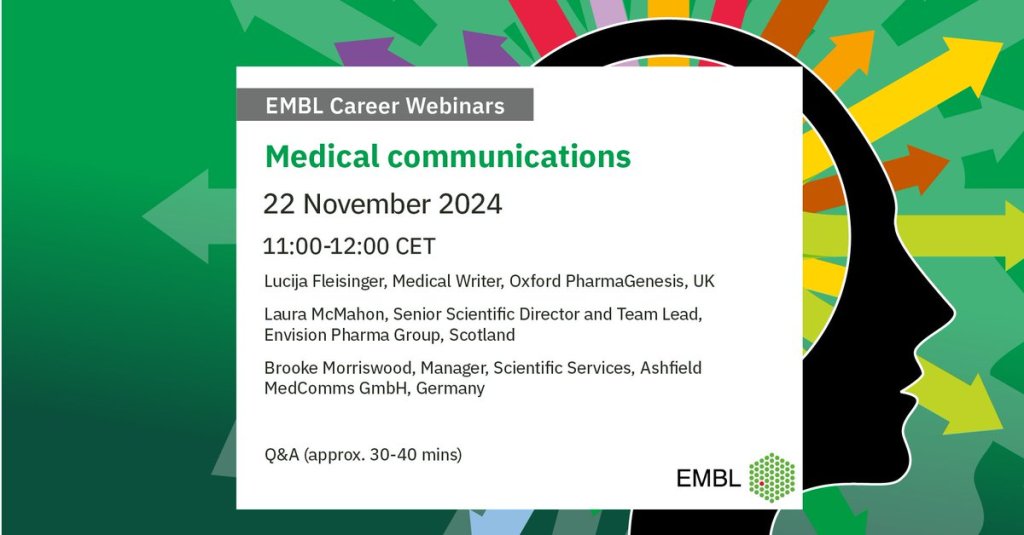
Medical Communications (MedComms) might just be the best industry career option out there for scientists who most enjoy the writing/communicating/organising parts of the job, and on 22nd November 2024 the EMBL Fellows’ Careers Service hosted a webinar about it. The panel members were:
- Lucija Fleisinger, Medical Writer, Oxford PharmaGenesis, UK
- Laura McMahon, Senior Scientific Director and Team Lead, Envision Pharma Group, Scotland
- Brooke Morriswood, Manager, Scientific Services, Ashfield MedComms GmbH, Germany
Each speaker gave a short presentation on their career path and experiences in MedComms, which was followed by a general Question & Answer session chaired by Patricia Cabezas and Rachel Coulthard-Graf. An edited and expanded transcript of the Question & Answer session is below.
QUESTION & ANSWER SESSION
Regarding the first transition from academia to MedComms, often in the job advertisement they require specific knowledge about the European regulations. Did you do any specific training before applying?
Lucija: I had no specific training. And I have to say, that at least in the UK, for most Associate Writer positions, prior experience in MedComms is not required. I know of a lot of people who have transitioned straight from academia without previous experience. If you bring communication skills from academia, that can definitely benefit you. If you’ve written papers, if you’ve presented at conferences, that helps. I had to do a writing test as part of my interview process, so that writing test is your opportunity to demonstrate your writing skills, and the attention to detail that you have acquired so far. But yes, in my experience prior experience is not needed. I think a lot of people come directly from academia.
Rachel follow-up comment: Brooke concluded with a nice list* of things you can do to prepare generally. Was there anything more specific that you did?
Lucija: No.
(*Make sure you write up your own research, offer to edit the work of your colleagues, get acquainted with PowerPoint/Word/Teams/Outlook/Excel [in that order!], practise event management in PhD&postdoc retreats/seminars/workshops/symposia, follow the latest news stories.)
How does MedComms compare to academic research if you are looking for a position that is ‘intellectually stimulating’?
Brooke: I think people that are into the writing, reading, communicating side of the job, you tend to think “Oh, I should go into publishing”, and I actually did interview for editorial roles. But I didn’t really click with it, because it felt like I would be outside the shop window with my nose pressed against the glass. For me, the huge appeal of MedComms is that you really are still involved in producing abstracts, posters, slide decks, manuscripts…it’s very much part of that creative content generation process.
In terms of the comparison with academia, I did struggle a bit early on, because you’re coming from a place where you know a lot and you’re the expert. And then suddenly, everything’s very unusual and strange. But what you find over time – I think this is something Peter Medawar said decades ago, “Anything is interesting once you start to study it in depth” – what you find with every therapeutic area is that the more you dive into them, the more interesting they get. And you know, suddenly, you find like, oh, wow!, oncology is this amazing thing, or haematology, and so on. The letting-go process of your own little niche is a wrench, and that does take some time. But what you learn is that this is an incredible opportunity to explore a much wider range of areas than you would be able to do otherwise, as Lucija mentioned.
Could you explain a little how what an interview looks like and what you’re looking for?
Laura: This can depend on whether you’re applying for a specific intake scheme. Both Ashfield and Envision Pharma Group have got a specific kind of Associate Medical Writer training scheme. For that you can have an interview day that is really quite full-on. There’s lots of different tasks throughout the day, and those are scored. You work in teams and you work by yourself so it can be a really kind of skills-focused interview day.
If you’ve already had some writing experience and you’re coming for a non-entry level position, there generally would be 2 or 3 people. Sometimes it will just be a chat, because you’ve already done a writing test. It’s then to see if you will fit in with the team in terms of your personality, your emotional intelligence, and how you like to work. This interview is often similar to other job interviews and entails a lot of behavioural questions: Can you think of a situation where you didn’t have much time, or you didn’t have the right resources to do a project, and how you overcame this difficulty? So, it would be really helpful for you to think of, you know, times you’ve overcome problems, times that you have worked with a colleague that you’ve had a clash with, times where you worked well as a team, examples that show that you can overcome obstacles, that you can problem solve. It is really how you can demonstrate the necessary skills from your previous work experience.
[NOTE: the EMBL Fellows’ Career Service has some resources here to help scientists prepare for these type of questions in non-academic job interviews.]
Does the number of publications that you have during the PhD or the postdoc period really matter for being interviewed and receiving an offer?
Laura, Brooke, and Lucija: Definitely not (all speakers shaking their heads).
For someone who has a long postdoc experience, can this be problematic and how should those people pitch themselves?
Brooke: Absolutely not, I even made it as far as group leader before I left academia. Most of the people entering the industry are doing so pre-PhD or post-PhD, but a PhD in itself is not a hard requirement. Just as an example, the highest qualification of one of the top people in our firm is a Bachelor degree. What I have realised though is that the longer you stay in academia, you do develop certain skills which are in themselves transferable. What you lose in terms of age and career terms, you kind of gain in terms of other skills which a younger applicant has not necessarily had the chance to gain. And that balances out.
I think for older scientists, perhaps postdocs who are thinking about making the jump at a later stage in their life, it’s important to be humble. I think you do have to be able to approach with a view like, okay, I’m starting afresh, I’m not going to know everything from day one. This is a learning process, and let’s see where I am in 2 years’ time. But really there is absolutely no cut-off, I think, in terms of when you can make the jump from academia.
For those who enjoy scientific illustration and the design aspects, is that a type of job within medical communications? Do those roles work in a different department?
Laura: Yeah, it’s a different department and I think all big agencies have a creative department. In the creative department, staff often don’t have any scientific background, so they can be graphical designers, for example. You don’t have to have a scientific background to get into the creative department. You can have, but I’m not sure how rewarding that would be scientifically, because it is often just redrawing things. Or there are teams that have to come up with a scientific design for a symposium, come up with new templates for things… so there are lots of strategic or really overarching themes and whole kinds of projects that you can come up with. But we usually have the scientific people, and then the creative people. It wouldn’t hurt at all if you did have a scientific background and you worked in the creative side of it…but I’m just not sure if it would be rewarding enough scientifically if you still wanted to be involved with that side of things.
How much do you use AI tools in MedComms these days and how do you see AI changing the kind of the job profiles and needs for the future?
Lucija: I think our company kind of sees it as both a challenge, but even more so an opportunity. But I think it’s early days, right? So, we’re trying out a lot of different things and really trying to understand where AI can add value and also where it can reduce the time that we spend on these really mundane, annoying tasks. And I think for me, that’s where I see the benefit in that some of the stuff that we do takes quite a lot of attention and time but not all of it is hyper-interesting. So, I think that’s one aspect where AI can do a lot for us. But I think it’s early days. So, I think everyone is really interested in seeing how it can help. But I don’t think it’s anywhere near like replacing us or anything like that. That’s my view.
Laura: And to maybe add to that as well that a lot of clients are embracing AI quite significantly for first drafts of short publications, for plain language summaries, abstracts, etc. So the writers are then doing the reviewing role, the more strategic role. There are already quite a lot of AI-written first drafts for some clients in some specific areas. If you are involved in professional publication organisations such as ISMPP, they often have webinars about AI, and how they’re being used in publications and the regulation that is kind of fighting to go alongside it. I think it will become very common to have short publications with a first draft generated by AI. In any case, you’d need to have a confidential, a proprietary AI, because all the information we work with is confidential, so you can’t use anything that is a ChatGPT or general AI. There are lots of clients generating their own confidential bespoke AIs, and I know EPG has an AI department, and I know other agencies do as well. So I expect this to change rapidly over the next few years, but yeah, there’s a lot of legislation needed and a lot of testing needed.
Brooke: Just to quickly add to that, there is an extreme caution on the part of industry about the use of AI, purely because of this issue of patient confidentiality. So, as Laura mentioned, all the data we work with is confidential, and people are taking extreme care to make sure that nothing that could be traced back to an individual patient ends up being used in an AI that could be linked back to them, or accessed more broadly. That means that the pace of uptake is perhaps slower than it is in academia at the moment, but that reflects the more regulated space that we’re operating in here.
Are you aware of any mentorship programs, companies that offer internships, or a way to test the waters with medical writing before committing to this career path?
Lucija: I would say, have the confidence to apply! If you’re unsure, though, and you feel like you want to test the waters first, there are lot of companies where you can do a short trial period and see what the job entails. I think that’s definitely an option that a lot of companies offer, but also just find people on LinkedIn and talk to them and have them share their experience. I think that’s a good way to start.
*** ADDITIONAL QUESTIONS – NOT ANSWERED LIVE ***
Do you ever feel like you “lost” your identity as a researcher? How was that grieving process?
Brooke: No – I am a scientist and I will always be a scientist, and scientists don’t only work in academia. But there’s definitely a wrench that comes with leaving academic research, because you’re leaving behind an area that you know very well and at least in this line of work, in MedComms, you’re always scrabbling to get up to speed and it’s easy to miss the comfort and security of a “home” field. But over time I’ve learned to relish the variety of science that this job brings, and of course the real-world relevance is absolutely baked-in, which in academia is rarely the case. I’d say it took me around a year to fully let go of my old research area, but the grieving period definitely ends at some point.
Could you tell us a bit more about the expected salary in MedComms?
Brooke: Obviously I can only speak from my own experience here, but I’m currently earning the same as I was as a junior group leader in a University environment. I don’t have a perspective on the range of salaries at the different levels of a MedComms career or how those same roles might be salaried in agencies compared to companies, but my naïve impression is that the private sector generally places a much higher value on individuals than the public sector, and pays accordingly.
Laura: I would say that MedComms pays very well compared with other life sciences career options and there are usually pensions and additional benefits too.
Rachel (EMBO Fellows’ Career Service): The European Medical Writers’ Association released some survey results in 2021 illustrating how much this depends on level, experience, country etc. The results can be downloaded here.
How is the MedComms work-life balance, and compensation as compared to an academic job?
Brooke: I’m finding it to be way better than academia, at least at the stage I’m at now. Right now, when I turn off my computer at the end of the day, that’s it – I’m offline and not working until I turn it on again the next morning. The intensity comes from trying to bill a very high percentage of your contracted hours each week, so you’re generally rushing through the day and trying to get things done as quickly and cleanly as possible. The corollary to that is that you need a good “off” switch, because you need to be able to let go of it all when the computer powers down. Site visits for advisory board meetings or congresses or results meetings are different – they will be very full-on and the days will be long, but they’re generally only a single overnight stay so it’s intense but short.
Laura: I would say that you need to have good boundaries for a work/life balance in MedComms or anywhere else. Our clients often work in high pressure environments and that can bleed over into unrealistic expectations. A good MedComms team will manage these expectations well but it really depends on your client, therapy area, lifecycle of the drug, etc. For example, if you’re working on a key drug just before launch, there is loads to do and it can get hectic with longer hours. I think also because people from academia can have a workaholic mindset (and we scientists have an unhealthy striving for perfection!) and then move to MedComms, you may find that some of your colleagues do not have a great balance. It’s up to you to respect others’ work boundaries and to put your own in place to avoid burnout.
In your job, do you get to choose/specialise in a field in which you do MedComms? For example, oncology or diabetes or do you communicate across different fields of research?
Brooke: If there’s a new client or project there might be a general e-mail asking if anyone has previous experience in a particular area, but most of the time you’re working in an assigned area. As you move from project to project and client to client though, you will get the chance to sample a range of different therapeutic areas – in just over one year, I’ve been able to work on haematology, oncology, ultra-rare genetic diseases, inflammatory bowel disease and even some immunology. To me this is one of the big plus points of the agency life.
When we start a MedComms job after a post-doc, will we still receive training or work with a senior before jumping into the job?
Brooke: There’s definitely a lot of learning-by-doing, but nobody is going to throw you in a hole and leave you. For any particular project, be it an abstract, a poster, a manuscript, whatever, there will generally be a medical writer assigned and a senior medical writer assigned – the senior will direct the writer’s work, review it and provide feedback, and take responsibility. One of the other humbling and amazing things about the private sector is the extent to which companies invest in individuals – I still find the notion of company-mandated compulsory training a wonderful thing. So some skills you’ll pick up on the job, some stuff you’ll be taught, and because it’s a very team-orientated environment, you’ll always be able to send up a flare if you’re struggling with something.
Laura: Agree about the strong team environment. A good team will help each other out and share experiences and learning, on top of regular training for specific topics.
How should a postdoc with journal editorial experience be pitching themselves as a suitable candidate for a Med Comms role?
Laura: I would say to emphasise your attention to detail, ability to synthesise difficult concepts and communicate them clearly to different audiences, essentially the discipline of the journalistic role, as many of these skills are also needed in MedComms.
Since most of your work is remote, does your organization recruit people based outside of the countries you operate in?
Laura: the companies I’ve worked for do sometimes, but they like to have people associated with an office to some extent – even if that just means the same country.
Lucija: As far as I know, Oxford PharmaGenesis does not routinely recruit people based outside of the countries it operates in (though it has offices in multiple countries).
POSTSCRIPT
Do you have any further questions on MedComms as a career? Then feel free to leave a comment below!
Lastly, a huge thanks to Patricia Cabezas and Rachel Coulthard-Graf of the EMBL Fellows’ Career Service for organising and hosting the webinar, and assisting with this posting.

 Total Internal Reflection