
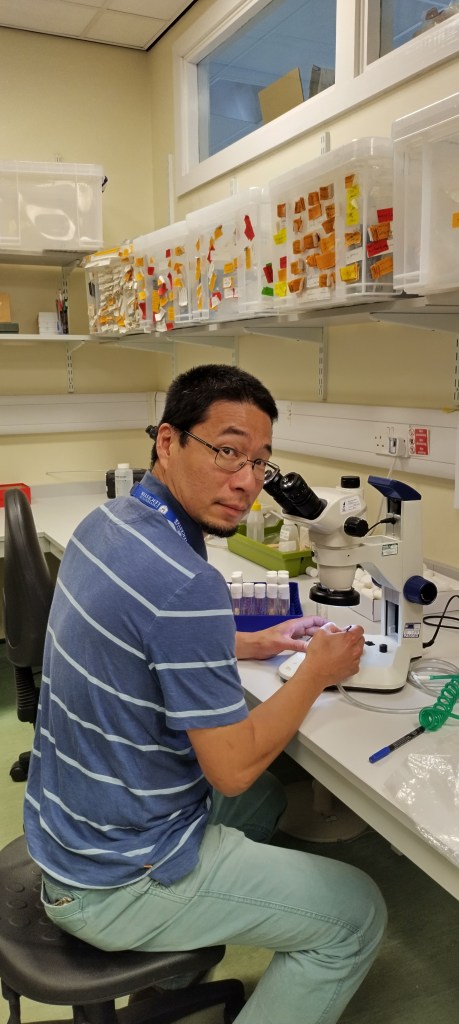
Ko-Fan Chen is a lecturer in Neurogenetics at the Department of Genetics and Genome Biology, University of Leicester (UK). He also runs a research lab to understand sleep. Here, he describes the moment ( his #MySciMoment) that set him on the path to a research career in academia.
The realisation of my interest in STEM, or more precisely research in biology, was a slow and accidental process, and there were many moments that could have changed my path. But a series of events at the end of my B.Sc degree was perhaps the most important junction that set me onto the path of STEM.
I grew up being much more interested in art and history than science (I still have those interests). The Taiwanese education system in my time was based on a strong social utilitarianism: law, engineering, and medicine degrees were strongly encouraged, whereas art, history, and sociology were seen as aristocratic luxuries. Against this background, a choice of the STEM stream at high school was just a trendy and safe thing to do, but then I chose to take a biology degree with the hope that I might eventually be able to follow biological illustration as a career.
I spent my 2nd year plant/animal anatomy course drawing many biological structures. While I enjoyed doing these at times, I also realised there was simply no job perspective as a biological illustrator in Taiwan. During our 4th years, we are encouraged to volunteer in the research labs to gain some understanding of how research works, and I went to a junior PI’s lab where I enjoyed the intense interaction and debate about technical and research ideas. But I was still longing for an art-related career.
I therefore spent my last summer at university in a Design cramming school, where they intensely train people for entrance exams to Design college. On one occasion, the teacher asked us to do a mock pitch of a design concept, where he draws 7 shapes on the blackboard (see image below based on my memory).
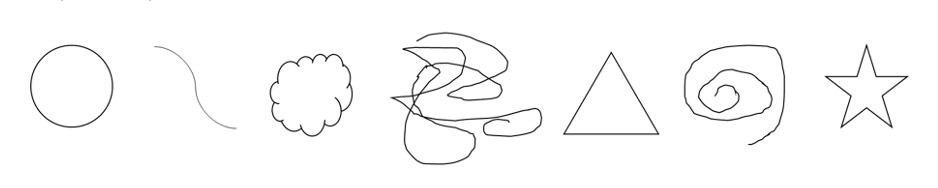
I immediately noticed a pattern: they are alternating forms with joined and loose ends, so I stepped up to the podium, talked about the patterns, and tried to come up with a narrative about why the design is like this. The teacher was impressed by my observation as that was not what he intended, but not so sure about my actual justification of the design (which I cannot remember).
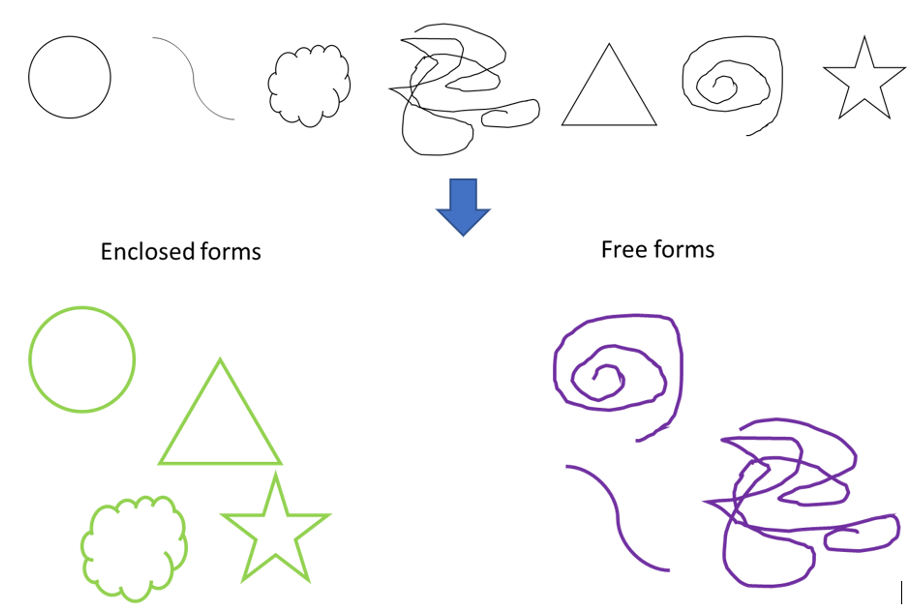
After that day I kept thinking about this event and eventually realised that through the training I had from my biology degree I had become someone that enjoys finding and analysing natural patterns.
So I decided to go for a two-year MSc degree in the lab and I have been enjoying doing research since, with numerous times rushing to show my peers the exciting data I just found.
Looking back, if I was talented enough or my environment was more encouraging to do art, I might not be here describing my following of a STEM career. But I am glad I chose research.
Are you a BIPOC/BAME scientist and would like to share your #MySciMoment – your story of what inspired you to pursue a career in STEM? Leave a comment if so.
 Total Internal Reflection